Security Screening for Factories and Industrial Sites
2026-09-21 · 7 min read
Factories and industrial sites face a screening problem that is different from a mall or an office: large shift waves, contractors and delivery vehicles mixed in with employees, and a real loss prevention concern on the way out as well as the way in. This guide covers how plants use metal detectors and X-ray bag scanners at entrances and exits to reduce theft, contraband, and safety risks — and how to layer that screening with access control and guard patrols for plant entrance security that holds up at shift change.
Key takeaways
- This is entrance and exit screening of people and bags, not in-line product inspection.
- Entrances and exits are the control points because almost everything passes through them.
- Run the arch on the way in and on the way out — exit screening is where loss prevention pays off.
- Plan throughput for the shift-change spike, with separate lanes for staff, contractors, and visitors.
- Layer screening with access control and guard patrols to close the gaps a single checkpoint leaves.
Why entrances and exits are the control points
To be clear from the start: this post is about screening people and bags at factory and industrial site entrances and exits — not in-line product inspection on a production conveyor. Those are different problems with different equipment, and conflating them is a common source of confusion when a plant first scopes a security program.
Entrances and exits are the control points because almost everyone and everything that moves in or out of the site passes through them. A checkpoint at the gate catches prohibited items on the way in and deters theft on the way out, and it does so at a fixed, staffed location rather than across a sprawling site. That concentration is what makes the investment worthwhile.
Screening people: walk-through and handheld detection
People screening at a plant gate usually starts with a walk-through metal detector at the entrance. Every person passes through, and anyone who alarms gets a secondary check with a handheld wand. The arch gives a consistent signal that does not depend on a guard’s visual judgement, which matters at a gate that sees hundreds of people per shift.
Exit screening is the mirror image and is often where loss prevention pays off. Running the same arch on the way out flags tools, components, or raw material someone is trying to carry out, and the visible checkpoint alone changes behaviour over time. Pair the arch with a clear policy on what employees may and may not take through the gate.
Screening bags and parcels with X-ray
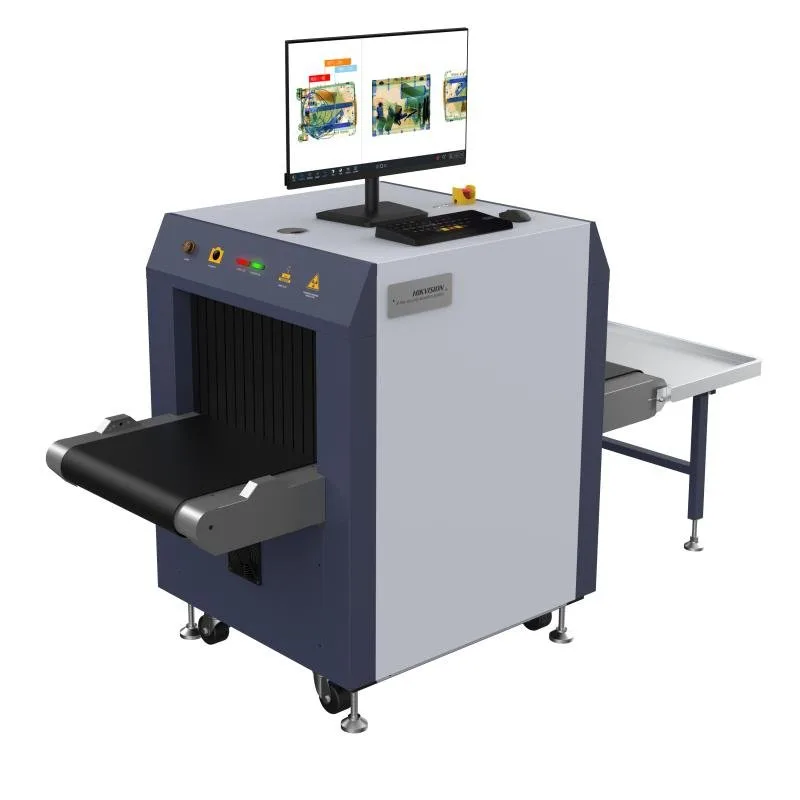
Bags, lunchboxes, backpacks, and delivery parcels need a different tool. An X-ray baggage scanner lets an operator see inside a bag without opening it, which keeps the line moving at shift change when dozens of people arrive at once. For a plant, size the tunnel to the largest item people realistically carry — toolboxes and delivery boxes are bigger than office backpacks.
Run bags and people in parallel where possible: the arch handles the person while their bag goes through the scanner, so neither queue blocks the other. At exits, the same scanner can review bags being taken out, with the operator looking for items that should not be leaving the site.
Shift-change throughput and separate lanes
A factory gate’s hardest moment is shift change, when one shift leaves and another arrives in overlapping waves. Throughput has to be planned for that spike, not for the quiet middle of a shift. If a single arch cannot clear the wave, add a second arch in parallel or stagger shift start times so the peak spreads out.
Separate lanes for staff, contractors, and visitors keep the flow orderly. Staff pass through daily and can move quickly once they know the routine; contractors and visitors need more time for logging and credential checks, and mixing them into the staff lane is what creates bottlenecks. Tie each lane to an access control reader so the screening record links to a named person.
Combining screening with access control and guard patrols
Entrance screening is one layer, not the whole program. Link it to access control so every screened entry is tied to a badge or credential, and the gate record shows who came through, when, and whether they alarmed. That turns a screening event into a reviewable data point instead of a moment that vanishes once the person walks past.
Between entrances, a patrol guard system confirms guards are actually covering the perimeter, warehouses, and yards that the gate cannot see. The same approach applies to corporate facilities — detection at the door, accountability across the site. Layering these is what closes the gaps a single checkpoint leaves open.
Program checklist
Use this checklist when scoping a factory or industrial site screening program. Confirm each item against your actual entrances, shift schedule, and the people who pass through.
| Consideration | What to confirm |
|---|---|
| Scope | Confirm entrances and exits covered, and who is screened (staff, contractors, visitors) |
| People screening | Walk-through arch plus handheld wand for secondary checks |
| Bag screening | X-ray scanner sized to the bags and toolboxes people carry |
| Lanes | Separate lanes for staff, contractors, and visitors at shift change |
| Access control | Badge or credential check tied to the screening record |
| Patrol coverage | Guard patrol checkpoints for areas between entrances |
| Logging | Incident and exception log reviewed on a set schedule |
Frequently asked questions
Is this the same as product inspection on the production line?
No. This post is about screening people and bags at factory entrances and exits — catching prohibited items on the way in and deterring theft on the way out. In-line product inspection on a production conveyor is a different application with different equipment, and the two should not be conflated when scoping a security program.
Do we need to screen on the way out as well as the way in?
Exit screening is where loss prevention often pays off. Running the same walk-through arch and bag scanner on the way out flags tools, components, or raw material being carried out, and the visible checkpoint alone changes behaviour over time. Many plants screen in both directions once the entrance checkpoint is running smoothly.
How do we handle the shift-change rush?
Plan throughput for the shift-change spike, not the quiet middle of a shift. If a single arch cannot clear the wave, add a second arch in parallel or stagger shift start times. Separate lanes for staff, contractors, and visitors keep the flow orderly and let credential checks happen without blocking the staff lane.
Getting started
If you are scoping screening for a plant gate or tightening an existing exit-check program, our team can help you size the equipment and plan the lanes for your shift schedule.